
How to Check Criminal History in Brooklyn
Brooklyn searches work best when the request follows the event. The official city site does not identify a city police department or dedicated police records counter. Do not infer a contract arrangement from that silence. City Hall can confirm current local routing, while the Poweshiek County Sheriff is the published public law-enforcement contact. Filed cases belong in Iowa Courts Online.
Use this Brooklyn record-check sequence:
- Read the citation, report heading, or other notice to identify the arresting or investigating agency.
- Confirm current local law-enforcement routing with Brooklyn City Hall when the creator is unclear.
- Call the Poweshiek County jail for present custody because no official public county roster exists.
- Search Iowa Courts Online under Poweshiek County for any filed criminal, traffic, or ordinance matter.
- Use Iowa DCI only for the statewide Iowa repository product, not as a real-time Brooklyn booking log.
This order keeps a Brooklyn city record, county booking, and state court file from being mistaken for the same document.
Identify the Brooklyn Arresting Agency
Agency identity matters in Brooklyn because I-80, U.S. 6, county roads, and city streets can bring different officers into the same area. A Poweshiek deputy keeps the sheriff narrative. An Iowa State Patrol trooper’s report begins with the patrol. If another sworn agency handled the event, that agency remains custodian of its report even when the person was booked in Montezuma or the charge was filed in Poweshiek County.
Look for an agency name, incident number, officer unit, or crash-report instruction on the paperwork. If none is available, provide Brooklyn City Hall or county dispatch with the date, time, and place and ask which public office should receive the request. That is more accurate than sending an open-ended request to every nearby office. Once the creator is known, ask separately for an incident narrative, crash report, dispatch record, or video because each can have its own review and redaction process.
Note: A Brooklyn street address identifies where an event occurred, but it does not prove which public agency created and holds the report.
The Brooklyn Police Department
Current first-party research found no Brooklyn police-department page, police request form, arrest log, records portal, or department app on the official city site. The city directory does not list a city police department. The defensible route is to call Brooklyn City Hall at 641-522-7066 to confirm the current arrangement, then contact the Poweshiek County Sheriff at 641-623-5679 for county law-enforcement and jail records. No specific contract, coverage agreement, office hours for a police desk, or city report fee should be assumed.
City Hall is at 138 Jackson Street, with mail sent to P.O. Box 145, Brooklyn, Iowa 52211. Fax is 641-522-5584. Staff can address city-created administrative material and clarify routing, but they should not be described as the custodian of a sheriff report or state court case. The creator-and-custodian rule under Iowa law remains the safest way to frame Brooklyn record access.
The official Brooklyn contact page is the verified city starting point for that routing question.
The city contact source documents a real local channel without inventing an unconfirmed Brooklyn police records office.
Brooklyn’s Custodian Gap Changes the Request
The lack of a published Brooklyn police desk is useful information. It means a requester should state what is known and ask the official city or county contact to identify the holder. Include the event date, a narrow time range, location, involved name, and incident number if one appears on a citation. Ask whether the record is a city administrative item, sheriff incident file, jail booking, State Patrol report, or court case.
For law-enforcement material held by the sheriff, Iowa Code chapter 22 provides the formal inspection and copy route. The sheriff has no downloadable criminal-report form or general request portal. Call during posted office hours, visit 4802 Barnes City Road in Montezuma, or mail P.O. Box 297, Montezuma, Iowa 50171. State whether inspection, electronic delivery, paper, or certification is desired. No official sheriff report fee was located, so request an estimate.
The official City of Brooklyn website confirms the municipal source used to check current city contacts.
Its lack of a police portal supports the transparent fallback to City Hall, the sheriff, and the state court system.
Arrests and Bookings in Brooklyn
Persons taken into custody from Brooklyn enter the Poweshiek County jail system at the Public Safety Building in Montezuma. Call 641-623-5679 for present custody, booking, bond, and release information that may lawfully be disclosed. The county publishes no verified online roster, booking blotter, jail app, or city arrest feed. An older booking document requires a sheriff records request.
A citation can create a court docket without a jail booking. Likewise, an arrest-stage charge may be amended, declined, or dismissed before final disposition. The Brooklyn event report, county jail entry, prosecutor filing, court docket, and DCI cycle each answer a different question. Search the court after charging and allow for processing lag. Iowa guidance says a citation can take up to 14 days to post.
For a deeper county custody route, the Poweshiek County arrest history page separates arresting-agency, jail, court, and DCI channels.
Brooklyn Addresses Need Agency Context
Brooklyn is known as the Community of Flags. The city’s official history traces the display to an avenue of flags created for RAGBRAI in 1991 and later made permanent near I-80 and U.S. 6. That setting is local context, not justice data. Its practical records lesson is that a Brooklyn location near major roads can involve city administration, county deputies, or state troopers.
Do not turn a city address into an assumption about the record holder. For a crash or traffic stop, identify the investigating agency from the citation or report number. For a registry address search, use the official Iowa Sex Offender Registry rather than a city crime map. For a filed charge, narrow Iowa Courts Online to Poweshiek County. Each system uses the address for a different purpose.
No Brooklyn-only official crime annual report or arrest series was located. County totals cannot be relabeled as Brooklyn figures, and incomplete agency data should not be converted into a local crime rate.
Brooklyn Municipal Court Records
Brooklyn does not operate a stand-alone public municipal court search. Iowa’s unified District Court handles filed matters, including local ordinance, traffic, and criminal cases that enter the state trial-court system. Select Poweshiek County in Iowa Courts Online and use a case number when possible. A name search may return namesakes, so confirm county, case type, filing date, and each count.
| Court Name | Iowa District Court for Poweshiek County, Judicial District 8A |
|---|---|
| Case Types Heard | Filed Brooklyn-related ordinance, traffic, misdemeanor, felony, and other trial-court matters |
| Case Lookup Channel | Iowa Courts Online, then the Poweshiek County Clerk of District Court for public documents |
| What the Docket Shows | Filed counts, case events, hearings, dispositions, judgments, sentences, and public financial data |
| Copies & Fees | Confirm document availability and current plain or certified-copy charges with the clerk |
The clerk at 302 East Main Street in Montezuma holds the official filed case. A police or sheriff narrative does not become a court document merely because prosecution follows.
Brooklyn City Code Is Not a Docket
Brooklyn publishes a municipal code hub that includes Chapter 60, Administration of Traffic Code, and Chapter 70, Traffic Code Enforcement Procedures. Those legislative chapters state city rules and procedures. They do not list defendants, filed charges, hearing dates, or case outcomes. A reader can use the code to understand an ordinance, but must use Iowa Courts Online and the clerk for a specific case.
The official Brooklyn general code provisions show the distinction between the city’s laws and the judiciary’s case records.
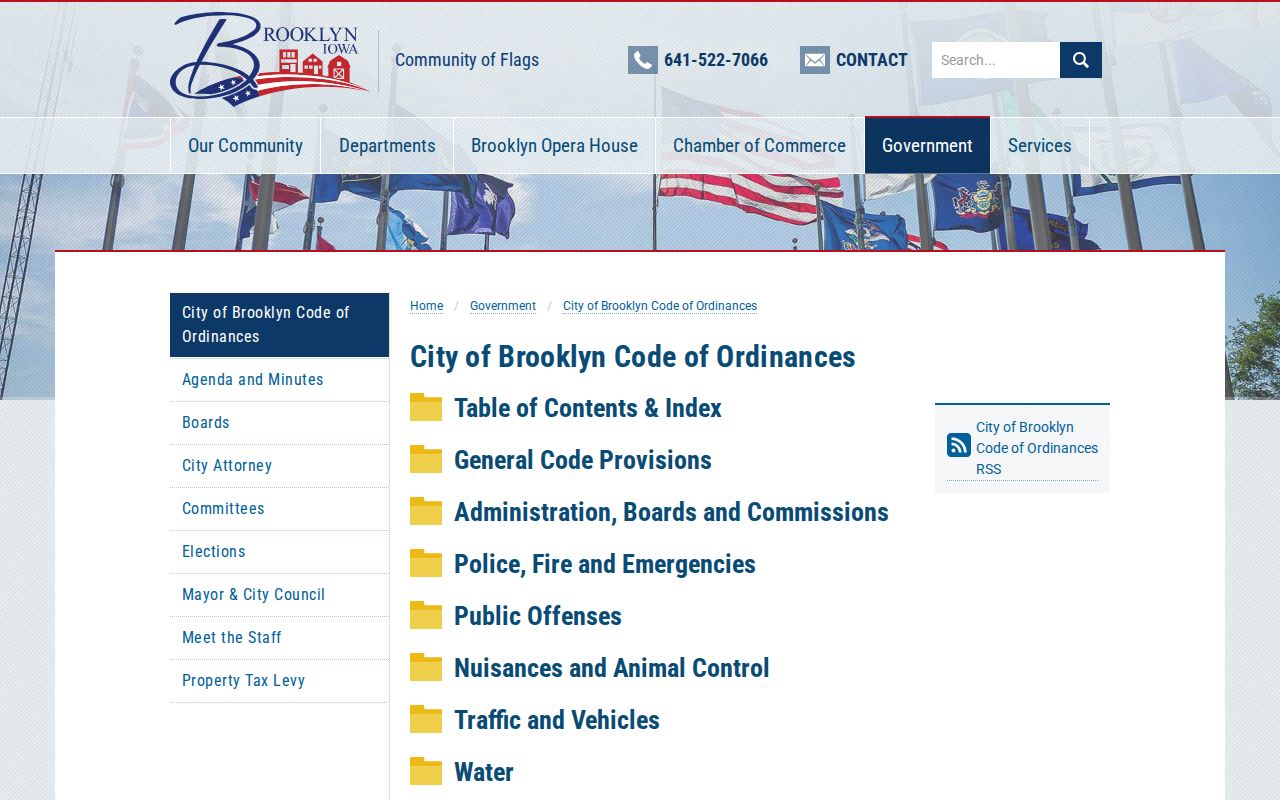
This city source can explain the rule cited on a notice, while the state docket reveals whether and how the matter moved through court.
City Council minutes and ordinances also remain City Hall records. They should not be searched as though they were a Brooklyn arrest history. Ask the custodian for the exact class of record needed.
Where Brooklyn Records End Up
A Brooklyn event can move through several custodians. The investigating agency creates the report. A custodial arrest produces a Poweshiek jail booking. The county attorney decides what to file, and the Clerk of District Court opens the state trial-court case. Courts report dispositions to the Iowa Department of Public Safety, Division of Criminal Investigation.
Record flow: Brooklyn event and investigating agency › Poweshiek County Jail and District Court › Iowa Department of Public Safety, Division of Criminal Investigation
The first box cannot honestly be labeled “Brooklyn PD” because the official city directory lists no such department. That custodian gap must remain visible. Confirm the agency, then follow the same county and state path. A DCI response is Iowa-wide but is not a substitute for a fresh incident report or pending court docket.
Compare Brooklyn Record Products
Three records often get merged in casual speech even though they prove different things. Keeping them separate makes a Brooklyn search more accurate and reduces false conclusions from one blank result.
| Product | Best Evidence Of | Does Not Prove |
|---|---|---|
| Agency report | The reported event, officer action, and alleged basis | That prosecutors filed the same count |
| Jail booking | County custody, intake charge, bond, and release | Guilt or final disposition |
| Court file | Filed counts, hearings, orders, outcome, and sentence | Every detail in the original agency narrative |
If one source is missing, move to the custodian that answers the actual question. A cited release may explain why a court case exists without a jail booking.
Plan a Brooklyn Chapter 22 Request
Once the holder is known, a narrow chapter 22 request should identify the record type, date and time span, location, incident number, involved name, and desired format. Ask for an estimate before paid work begins. Public offices may redact protected information, but a request can seek the nonconfidential remainder. If the office is not the custodian, ask it to identify the correct official channel without assuming transfer.
- City record
- Brooklyn ordinances, minutes, and municipal administration held through City Hall.
- Agency narrative
- The investigating office’s account of the event and alleged offense.
- Booking record
- The sheriff’s county jail intake and release record.
- Court case
- The clerk-held state file showing filed charges and judicial outcome.
These labels are especially useful in Brooklyn because no one city portal combines them.
Public Access Rules
Iowa law permits inspection and copying of public records while protecting confidential categories. Juvenile details, victim identifiers, medical information, protected addresses, confidential intelligence, and active investigative content may require withholding or redaction. Court sealing and expungement rules also affect ordinary access. Brooklyn City Hall, the sheriff, the clerk, and DCI each apply the law to records they maintain.
Key Statutes:
Iowa Code §22.2 establishes the right to examine and copy public records unless law makes them confidential.
Iowa Code §22.3 governs access arrangements and lawful actual-cost fees.
Iowa Code §22.7 lists confidential record categories public bodies must protect.
Iowa Code §692.2A limits dissemination of certain criminal-history information.
The open-records law does not turn City Hall into the custodian of a sheriff report or make the court clerk responsible for an Iowa State Patrol narrative.